
Data engineering is an increasingly critical role in today’s data-driven world. Data engineers are responsible for building and maintaining the infrastructure that allows data scientists, analysts, and others to access clean, reliable data that can drive business decisions and data products.
But what makes an effective data engineer? Let’s analyze the anatomy of a successful data engineer to understand the key technical and soft skills that combine to make someone excel in this role. As companies generate vast amounts of data daily, the need for skilled professionals to manage, interpret, and extract valuable insights from this data is at an all-time high.
If you’re looking to enhance your data engineering capabilities, contact us at TCM. Our proven expertise in IT Staffing ensures that your data infrastructure is in capable hands, allowing you to focus on leveraging data to achieve your business goals.
Educational Backbone
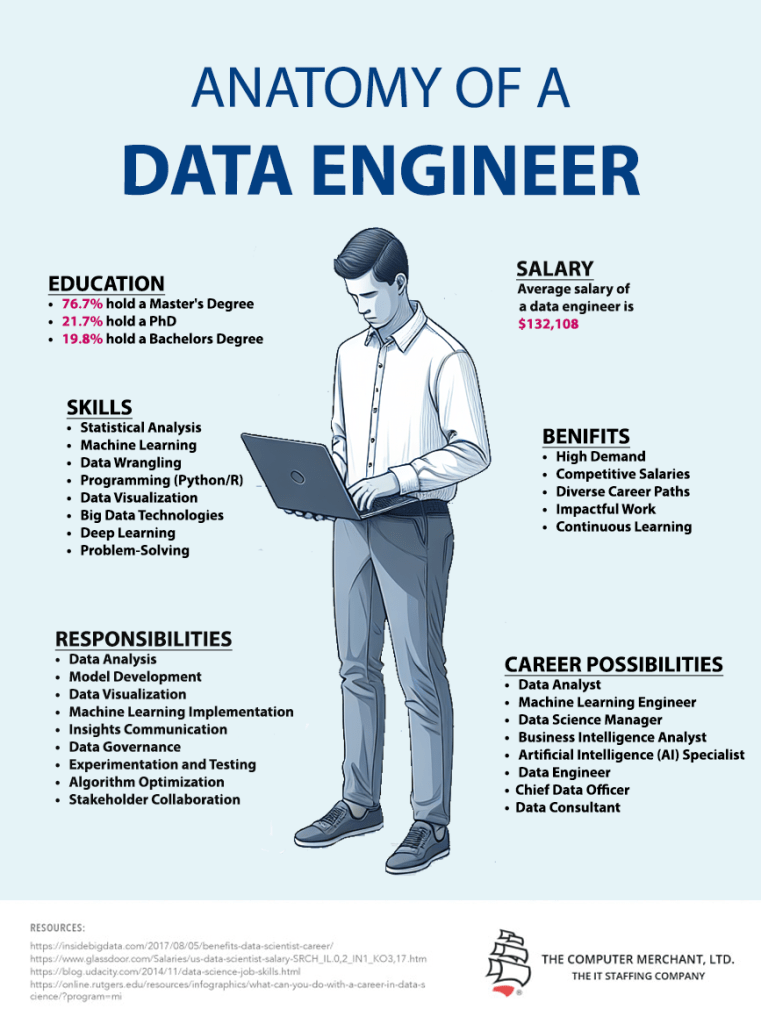
The educational qualifications of a data engineer are impressive. A substantial majority, 76.7%, holds a Master’s Degree, indicating advanced proficiency and specialized knowledge in their field. Meanwhile, 21.7% step it up with a PhD, offering a deep dive into data complexities. The remaining 19.8% possess a Bachelor’s Degree, equipping them with a solid foundation to start their career journey.
Technical Core Competencies
At their core, data engineers need a strong foundation in several key technical areas:
Data Pipelines & Architecture
Data engineers excel in crafting, deploying, and managing intricate data pipelines, channeling data from its origins to warehouses, lakes, and marts for insightful analysis. They architect scalable, efficient, and automated infrastructures, vital for modern businesses to harness the power of their data. At TCM, we provide the expertise and support to ensure your data infrastructure meets these high standards.
Key skills include:
- Designing data flow architectures
- Coding data pipelines
- Connecting diverse data sources and systems
- Orchestrating complex data movement
- Monitoring and managing data pipelines
Data Modeling & Warehousing
Data engineers must deeply understand how to model data to enable diverse analytical use cases. This starts with normalizing raw data into efficient relational models or flexible non-relational designs.
Critical abilities include:
- Logical and physical data modeling
- Database design and optimization
- Warehouse schema development
- Metadata management
- Master data management
Big Data & Cloud Tools
Data engineers must be fluent in big data platforms like Hadoop, Spark, and Kafka, as well as cloud platforms like AWS, GCP, and Azure. This focuses on leveraging managed services over infrastructure management.
Relevant skills include:
- Configuring and orchestrating big data platforms
- Building cloud data solutions
- Leveraging serverless options appropriately
- Monitoring costs and performance optimization
Skill Set Framework
The technical and analytical skills required are extensive:
- Statistical Analysis: Understanding and applying statistical methods is crucial for interpreting data.
- Machine Learning: Knowledge of algorithms and data models lets them predict future trends and patterns.
- Data Wrangling: Cleaning and organizing raw data is vital for accuracy and reliability.
- Programming: Proficiency in languages such as Python and R is non-negotiable for scripting and automation.
- Data Visualization: Turning complex data into understandable graphics is an art that improves decision-making.
- Big Data Technologies: Skills in handling large-scale data systems are necessary for managing the volume, velocity, and variety of big data.
- Deep Learning: It’s the cutting edge, allowing engineers to dive into complex data analysis with neural networks.
- Problem-Solving: A logical and systematic approach is essential for tackling data challenges.
Soft Skills & Mindsets
Beyond pure technical competency, several important soft skills take data engineers from good to great:
Collaboration & Communication
Data engineers must collaborate with IT, data consumers, executives, and more to understand needs and distill complex concepts for broad audiences.
Key abilities include:
- Active listening and requirements gathering
- Explaining technical concepts clearly
- Collaborating across functions
- Documenting architectures and systems
Business Acumen
Data engineers who understand business goals and metrics can build more impactful data solutions tailored to driving key outcomes.
Important knowledge areas encompass:
- Business analysis skills
- Translating data findings into business impacts
- Focusing designs around business priorities
- Incorporating feedback into iterations
Problem-Solving Mindset
Great data engineers approach problems with tenacity and creativity – pursuing solutions even when a straightforward path is not apparent. This enables discovering options others may miss.
Hallmarks of this mindset:
- Relentless, methodical troubleshooting
- Thinking outside the box
- Proactively identifying edge cases
- Pushing solutions past initial obstacles
Responsibilities Core
The day-to-day responsibilities are as varied as they are critical:
- Data Analysis: Interpreting data to find actionable insights.
- Model Development: Building predictive models that can forecast trends and outcomes.
- Data Visualization: Crafting clear visual representations of complex data.
- Machine Learning Implementation: Applying ML techniques to improve and automate processes.
- Insights Communication: Translating data findings into understandable terms for stakeholders.
- Data Governance: Ensuring the integrity and privacy of data.
- Experimentation and Testing: Trying new approaches and testing for the best results.
- Algorithm Optimization: Refining algorithms for peak performance.
- Stakeholder Collaboration: Working with various departments to implement data-driven strategies.
Financial Structure
The financial rewards for data engineers reflect the high demand for their skills. With an average salary of $132,108, it is a lucrative field that rewards the depth of knowledge and experience that these professionals bring to the table.
Benefits and Perks
The role comes with a host of benefits:
- High demand for skills.
- Competitive salaries.
- Diverse career paths within industries like healthcare, finance, and technology.
- The satisfaction of doing impactful work that drives business success.
- Opportunities for continuous learning and growth.
Career Possibilities Expansion
Career growth for data engineers can take several directions:
- Data Analyst: Interpreting data to inform business decisions.
- Machine Learning Engineer: Specializing in algorithms and neural networks.
- Data Science Manager: Leading teams to solve complex data problems.
- Business Intelligence Analyst: Turning data into insights for strategic planning.
- AI Specialist: Innovating with artificial intelligence to enhance automation and insights.
- Chief Data Officer: Overseeing a company’s data management strategy.
- Data Consultant: Providing expert advice on data management and strategy to businesses.
Anatomy Summary
In summary, the anatomy of a data engineer is complex and dynamic, reflective of a role central to modern businesses’ functioning. These professionals are the backbone of data-driven decision-making, and as the digital universe continues to expand, their role will only grow in importance and influence. The world of data engineering is indeed robust, offering a rich tapestry of opportunities for those with the passion and skills to dive into its depths.
Master data engineers require technical strengths in key areas like data pipelines, modeling, warehousing, and architectures paired with soft skills for collaboration, communication, and problem-solving to drive business success. For organizations looking to harness the full potential of their data assets, partnering with a seasoned IT staffing firm like TCM can provide access to top-tier data engineering talent. With a proven track record in placing skilled professionals in critical data roles, TCM is the go-to partner for companies aiming to elevate their data capabilities and achieve their strategic objectives.